Introduction
Not long ago, receiving high-quality medical care meant one thing going to a hospital or clinic. Patients traveled to appointments, waited in crowded waiting rooms, and depended entirely on the physical infrastructure of traditional healthcare settings. That model, while still important, is changing rapidly and fundamentally.
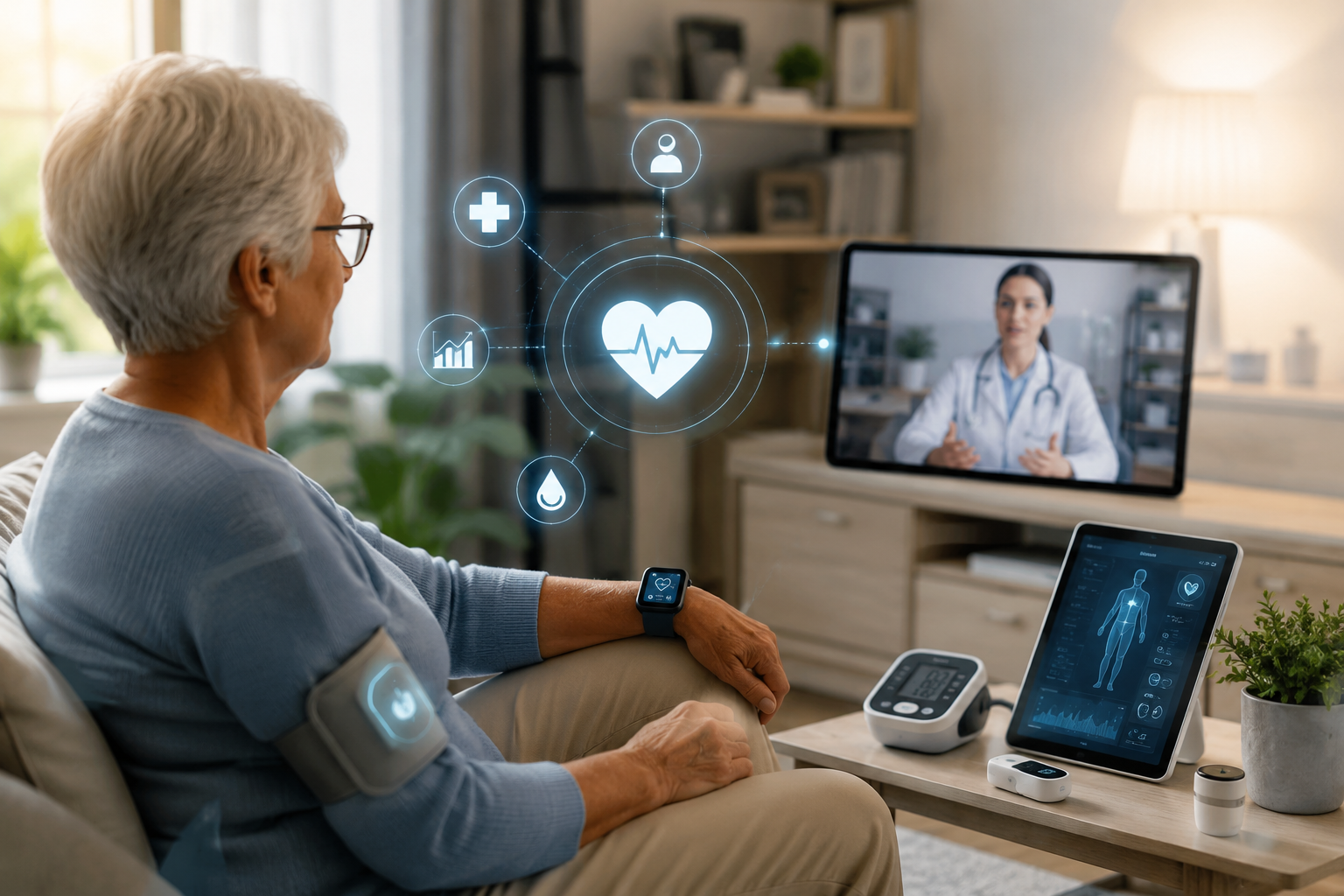
Future healthcare technology is transforming at-home care from a reactive treatment model into a proactive, predictive, and personalized healthcare system. Today, patients can monitor chronic conditions from their living rooms, consult specialists via video call, receive AI-powered early warnings about health risks, and have medications managed automatically — all without leaving home.
This shift is not a distant vision. It is happening right now, and the numbers confirm it. According to McKinsey and Company, up to $265 billion worth of healthcare services could shift from traditional facilities to home-based care. The World Health Organization projects that by 2030, one in six people globally will be aged 60 or above, significantly increasing the need for long-term home support. Deloitte’s 2024 Global Healthcare Outlook found that digital health adoption among healthcare providers rose by over 60 percent post-pandemic, with remote patient monitoring cited as a top investment area.
The hospital of the future is not a building. It is a network of connected homes supported by intelligent technologies. This article explores the key innovations driving that transformation and what they mean for patients, caregivers, and healthcare systems worldwide.
Why At-Home Care Is Becoming the New Standard
Several powerful forces are converging to accelerate the adoption of home healthcare technologies.
An ageing global population is perhaps the most significant driver. By 2034, the United States will have more adults over 65 than children under 18. Older individuals are more likely to suffer from chronic diseases, need continuous monitoring, and prefer care in familiar, comfortable environments. Home-based care aligns perfectly with these needs.
The lasting impact of the pandemic fundamentally shifted how patients interact with care systems. Remote care became not just an option but a necessity during COVID-19. The result was a sustained surge in demand for remote monitoring, virtual visits, and digital prescriptions that has not reversed even as restrictions lifted.
Advancing technology at lower cost has removed the barrier of complexity and expense. What was once too expensive or complex like remote ECGs or cloud-based electronic medical records is now affordable and user-friendly. Patients and caregivers can access powerful diagnostics from tablets, wearables, and even smart televisions.
Patient preference is also a major factor. In 2022, 89.2 percent of US patients reported satisfaction with home-based care models. People want to recover, heal, and manage their health in familiar surroundings and technology is making that both possible and safe.
1. Remote Patient Monitoring The Foundation of At-Home Care
Remote patient monitoring (RPM) is the technological backbone of modern at-home healthcare. RPM uses digital devices to collect health data such as blood pressure, heart rate, oxygen levels, and glucose levels from patients at home. This data is transmitted securely to healthcare providers who can monitor trends, detect anomalies, and intervene proactively without requiring in-person visits.
Wearables, smartwatches, and connected devices can track vital signs such as heart rate, blood pressure, and blood glucose levels in real-time, with data sent directly to healthcare providers. This allows for timely medical interventions and reduces the need for hospital visits significantly.
A heart disease patient wearing a connected ECG patch that streams live data to their cardiologist is one example of how RPM is already changing lives. The cardiologist can identify concerning rhythm changes before a cardiac event occurs — intervening proactively rather than reactively.
The American Medical Association highlights that 2025 is seeing a major push toward truly integrating RPM and wearables into chronic disease management protocols, with value-based care arrangements increasingly dependent on this integration.
2. Wearable Health Devices Continuous Monitoring Without Disruption
Wearable health devices have become one of the most visible and impactful innovations in at-home care. From smartwatches and fitness bands to specialized biosensors, ECG patches, and heart monitors, these devices provide real-time data on a wide range of health metrics including heart rate, sleep patterns, activity levels, skin temperature, respiratory rate, and blood oxygen saturation.
What makes wearables genuinely transformative is their ability to provide continuous health monitoring without requiring any active effort from the patient. The data is collected passively and transmitted securely to cloud-based platforms where AI algorithms analyze it for anomalies.
This early detection capability can identify potential health issues days or even weeks before symptoms become noticeable, enabling truly proactive care rather than the traditional reactive model of seeking help only when something feels wrong.
Common wearable devices now used in at-home care include:
- Smartwatches — continuous heart rate, ECG, blood oxygen, and activity monitoring
- Continuous glucose monitors (CGMs) — real-time blood sugar tracking for diabetic patients without repeated finger pricks
- Smart patches — biosensors worn on the skin that track temperature, hydration, and cardiac data
- Connected inhalers — for asthma and COPD patients, tracking usage and lung function
- Smart scales — monitoring weight changes that indicate fluid retention in heart failure patients
3. Artificial Intelligence Predicting Problems Before They Happen
Artificial intelligence is one of the most powerful forces reshaping at-home healthcare, and its impact is growing rapidly. AI analyzes data from devices and health records to predict complications early, allowing timely intervention and better outcomes before a situation becomes an emergency.
AI and predictive analytics are helping anticipate problems before they become emergencies. By analyzing large volumes of patient data from wearable sensors, electronic health records, and historical clinical data AI systems can detect subtle patterns that would be invisible to human observation.
On the administrative side, the SVB Future of Healthtech 2025 report reveals that AI in provider operations is now the dominant driver of healthtech investment, accounting for 44 percent of total sector investment in 2025, up from 19 percent in 2021. Ambient AI documentation tools listen to patient-provider conversations and automatically generate clinical notes, reducing the time clinicians spend on administrative tasks. The SVB report found that 75 percent of healthcare providers reported improved work efficiency after adopting ambient AI documentation in 2024.
On the clinical side, AI-powered diagnostic tools can analyze data from wearable devices, flag abnormal patterns, and alert clinicians to potential health issues before they become emergencies. This shifts the fundamental dynamic of healthcare from waiting for symptoms to appear to anticipating and preventing them.
4. Telehealth and Telemedicine Breaking Down the Barriers to Access
Telehealth the delivery of healthcare services through digital communication technologies has moved from a niche option to a mainstream standard of care. Patients can now consult with primary care physicians, specialists, mental health professionals, and therapists via video call, secure messaging, or phone, without leaving home.
It is worth understanding the distinction between the two terms. Telehealth covers all remote care services, including education and patient support. Telemedicine refers specifically to diagnosis and treatment by clinicians via technology.
The benefits of telehealth for at-home care are significant:
- Reduced travel burden — particularly important for elderly patients, those with mobility limitations, and people in rural or underserved areas
- Faster access — many telehealth platforms offer same-day or next-day appointments that would take weeks in a traditional in-person setting
- Continuity of care — patients can maintain consistent relationships with their care team without gaps caused by logistical barriers
- Lower cost — telehealth consultations are typically less expensive than in-person visits for both patients and the healthcare system
- Mental health access — telehealth has dramatically improved access to mental health support, removing the stigma barrier and enabling people to seek help from the privacy of their own home
Are home healthcare services reimbursed by insurance? In many countries, yes. Medicare and private insurers increasingly cover teleconsultations, remote patient monitoring, and sometimes the cost of smart devices used in care plans.
5. Smart Home Technology and IoT Safety and Support for Independent Living
The Internet of Things (IoT) the network of connected devices embedded in everyday objects — is transforming the home environment into an active participant in health management.
Smart home technologies support aging in place by enhancing safety, medication adherence, fall detection, and continuous health monitoring without requiring patients to wear devices or actively engage with technology.
Key smart home health applications include:
Fall detection systems Motion sensors and AI-powered cameras can detect unusual inactivity or movement patterns that may indicate a fall or medical emergency, automatically alerting caregivers or emergency services.
Smart medication dispensers These devices remind patients when to take prescriptions, dispense the correct dosage, and alert caregivers if doses are missed. This is particularly valuable for older patients managing multiple medications.
Voice-activated health assistants AI-powered voice assistants allow patients to check symptoms, schedule appointments, contact their care team, or call for emergency help using only their voice crucial for those with limited mobility.
Connected home monitoring Environmental sensors track temperature, air quality, humidity, and activity levels, helping caregivers identify changes in daily patterns that might signal a health concern.
Smart beds and mattresses Some advanced systems can monitor sleep quality, movement, heart rate, and respiratory rate passively throughout the night, providing valuable health data without any active patient effort.
6. Hospital-at-Home Programs Clinical-Grade Care in Your Living Room
One of the most significant structural shifts in healthcare delivery is the emergence of formal “hospital-at-home” programs. These programs extend clinical-grade care including IV medications, regular nurse and physician visits, and continuous monitoring to patients at home rather than admitting them to a hospital bed.
The 2025 conversation in healthcare is moving toward truly developing best practices for hospital-at-home models and expanding their scope, particularly for managing acute episodes of chronic conditions like heart failure, pneumonia, and COPD exacerbations.
Hospital-at-home programs combine the clinical capability of inpatient care with the documented benefits of the home environment — reduced infection risk, faster recovery, greater patient comfort, and significantly lower cost. Studies have consistently shown that patients in hospital-at-home programs report higher satisfaction and, in many cases, better clinical outcomes than matched patients receiving traditional inpatient care.
7. Robotics and Automated Care Assistance
Robotic technology is beginning to play a meaningful role in at-home care, particularly for elderly patients and those with physical limitations.
Care robots can assist with tasks including medication reminders, physical therapy exercises guided by sensors, lifting and mobility assistance, and companionship monitoring for patients at risk of social isolation. While fully autonomous care robots are still primarily in development and early deployment stages, semi-automated assistive devices are already available and improving rapidly.
Robotic-assisted physical therapy tools allow patients recovering from strokes, joint replacements, or injuries to perform guided rehabilitation exercises at home — reducing the need for frequent clinic visits while maintaining the quality and consistency of therapy.
8. Telegenomics and Personalized Home Healthcare
One of the most exciting frontiers in at-home healthcare is the integration of genomic data into personalized care plans. As genetic testing becomes more affordable and accessible, patients can now obtain detailed information about their genetic health risks and use that information to guide preventive care from home.
AI-powered diagnostic tools can analyze massive datasets from wearable devices and remote monitoring systems, cross-referenced with genomic data, to identify patterns that indicate emerging health risks tailored specifically to the individual not just population averages.
This personalization represents a profound shift. Rather than treating symptoms or managing diagnosed conditions, personalized home healthcare powered by genomic and real-time physiological data allows care to be preventive, precise, and continuous.
Challenges That Still Need to Be Addressed
Despite the extraordinary progress, several important challenges remain in realizing the full potential of at-home healthcare technology.
Data privacy and security are significant concerns. The collection, transmission, and storage of sensitive health data creates real risks if not managed with robust cybersecurity protocols. Patients and healthcare systems must ensure that the convenience of connected care does not come at the cost of personal health data security.
Digital literacy and access remain barriers for many older adults and those in lower-income communities who may not have reliable internet access, the technical skills to operate complex devices, or the financial resources to purchase advanced wearables.
Integration across systems is an ongoing challenge. Health data collected by different devices, platforms, and providers often cannot be shared seamlessly creating fragmentation that limits the value of continuous monitoring.
Regulatory frameworks in many countries have not yet fully caught up with the pace of technological innovation, creating uncertainty for developers and providers alike.
Caregiver support is also critical. Technology can support human care but should not replace it. The growing home care workforce needs training, tools, and support to effectively integrate these technologies into daily care practice.
What This Means for Patients and Families
For individuals and families navigating health challenges, the advances in at-home healthcare technology represent something genuinely meaningful greater safety, more independence, earlier warning of problems, and a care experience that respects the preference of most people to remain in their own home.
The shift toward home-based care is not about cutting costs or reducing the role of healthcare professionals. It is about extending the reach of quality care to where people live their lives, supported by intelligent technology that monitors, learns, and communicates on their behalf.
Understanding and engaging with these technologies whether through wearables, telehealth platforms, or smart home devices — is becoming an increasingly important part of managing long-term health. For more guidance on supporting your health and wellbeing at home, explore the full Health and Healthcare section on Wellhealthcare.
Final Thoughts
The transformation of at-home care through technology is one of the most significant shifts in modern healthcare. Remote patient monitoring, AI-powered diagnostics, wearable devices, telehealth, smart home systems, and hospital-at-home programs are together creating a new model of care one that is proactive rather than reactive, personalized rather than generic, and delivered at home rather than in a distant institution.
The technology is here. The evidence supports it. The demand is growing. And for patients, families, and healthcare providers alike, embracing this future means better health outcomes, greater independence, and a more human experience of care wherever people call home.